Guide
The best AI music generator for each kind of job
Seven tools, forty identical briefs, five weeks, and no league table. The generator that is right for a game soundtrack is the wrong one for a birthday song.
 Casey Lindstrom
I spent five weeks with seven AI music generators and gave every one of them the same forty briefs. What I did not do at the end of it is put them in order from one to seven, and I want to explain why before you read another line.
A generator built to feed a mobile game with endless background music is not competing with one that writes a birthday song for somebody's mother. Ranking them against each other would hide exactly the thing you came here to find out.
So this is a list of categories instead: eight kinds of job, and for each one the tool I would actually pick. Every subscription below came out of my own pocket, each tool is scored against the same published rubric, and I read every price off the vendors' own pricing pages on 21 September 2026.
One of the eight is the odd one out. CustomSongwriter is not a generator you operate but a song written to your brief, so its score is measured on what arrives rather than on an interface. Same five criteria, same weights.
| Tool | Best for | Price | Sings | Score |
|---|---|---|---|---|
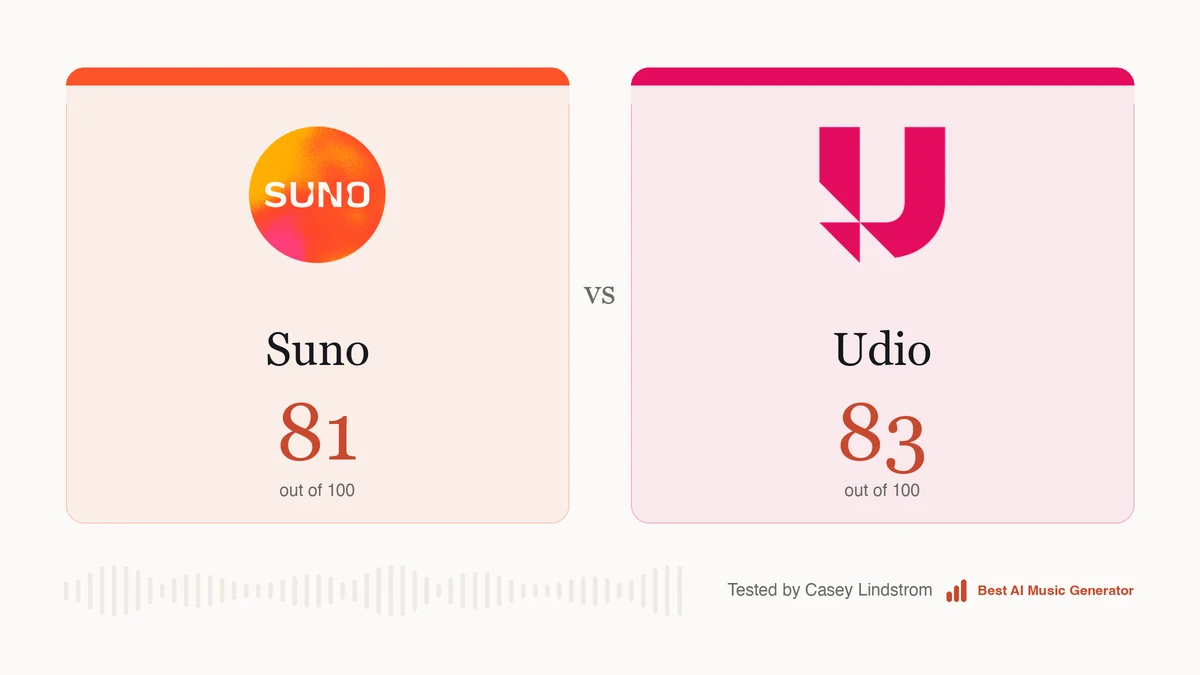
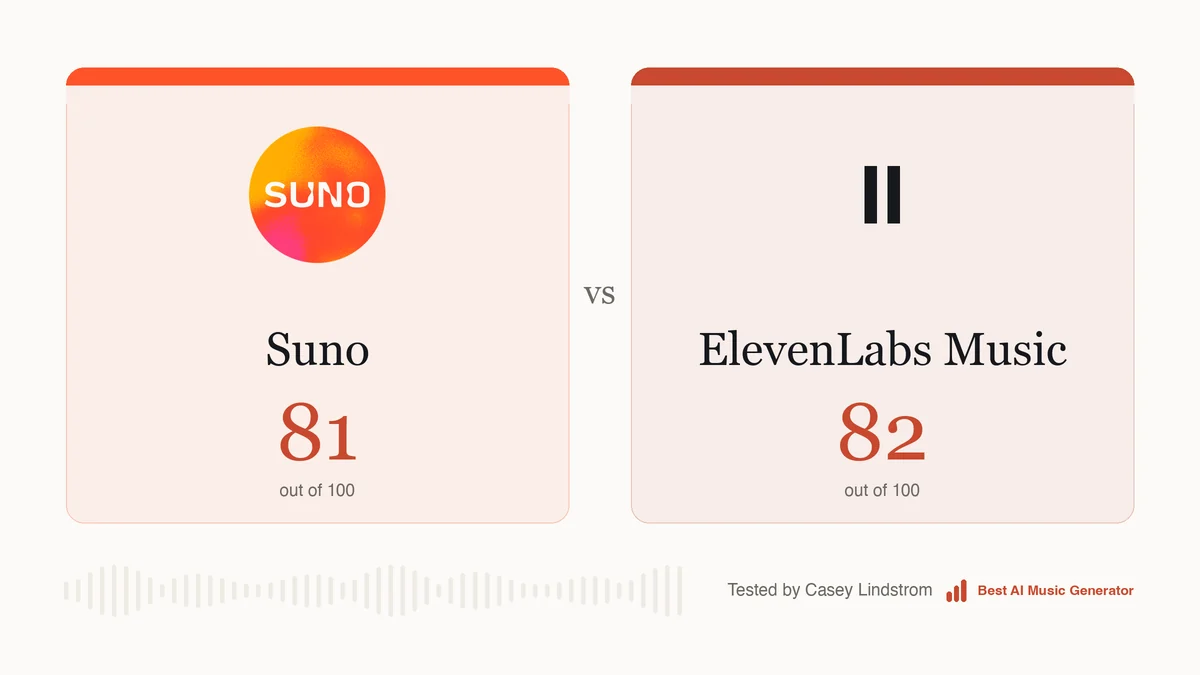
 Suno Suno | a finished song with vocals | 10 USD a month | Yes | 81 |
 CustomSongwriter CustomSongwriter | personal use, special occasions and no subscription | 29.99 USD once | Yes | 82 |
 Udio Udio | long tracks and fixing one section | 10 USD a month | Yes | 83 |
 ElevenLabs Music ElevenLabs Music | commercial and enterprise work | 6 USD a month | Yes | 82 |
 Soundraw Soundraw | video and podcast backing | 5.99 USD a month | No | 68 |
 Beatoven.ai Beatoven.ai | scoring to picture | 10 USD a month | No | 59 |
 Boomy Boomy | releasing to streaming services | 9.99 USD a month | Yes | 55 |
 Mubert Mubert | apps and games at volume | 14 USD a month | No | 50 |
Suno: best for a finished song with vocals
Suno is the best tool here for a finished song with vocals. Of the nine song briefs with a named person in the lyric, it handed me a take I would have sent to that person on the first generation five times. Nothing else managed more than three.
The voice is the reason. It sits inside the mix rather than hovering above it, with reverb and compression behaving the way they do on a record. That single thing is the most common giveaway in this field, and it is what makes friends ask who recorded the song.
What it cost me was a whole afternoon in the second week. A birthday song came back with a chorus I liked and a bridge that fell apart, and there is no way to ask Suno for the bridge alone. I rolled the entire song eleven times chasing that one section, and the eleventh was worse than the second.
The rights position is the weakest of the three singing tools, not because Suno has signed nothing, but because it has signed less. Two announced deals, Warner Music Group in November 2025 and BMG in August 2026, against Udio’s four, and Universal and Sony are both still litigating against it. For a song you are giving to somebody that changes nothing. For a song a client pays for, it is the reason I do not recommend it there.
- Output quality
- 27/30
- Vocals and language
- 17/20
- Rights and licensing
- 12/20
- Value
- 13/15
- Export and workflow
- 12/15
CustomSongwriter: best for personal use, special occasions and no subscription
CustomSongwriter is the best option on this page for personal use, for a specific occasion, and without a subscription. None of the seven generators write you a song at all. They hand you a generator, a monthly bill and an afternoon, and for a present that is the wrong shape of product.
CustomSongwriter is a one-off commission rather than a subscription. You write the brief, somebody writes the lyric and records it, you pay once, and then you never think about it again. I put this second rather than last because it is the job most people actually arrive here with.
The catalogue is built around occasions rather than genres, which is the right way round for this job: birthday songs, wedding and first-dance songs, anniversary and engagement songs, songs for a christening or a confirmation, leaving songs for a colleague, and funeral and memorial songs, where getting the tone wrong is the only real risk and a generator has no idea it exists.
You hear the first seconds and read the whole lyric before paying, and the preview asks for no card. The score below is measured on the delivered song rather than on an interface. Export and workflow is where it gives the most away: one MP3, no stems, no editing, nothing to regenerate a single verse with. What it buys back is that there is no interface to learn in the first place.
- Output quality
- 25/30
- Vocals and language
- 17/20
- Rights and licensing
- 16/20
- Value
- 13/15
- Export and workflow
- 11/15
Udio: best for long tracks and fixing one section
Udio is the best tool here for long tracks and for fixing one section. It is the only one on this page where a song is a thing you work on rather than a thing you roll: I mark the second verse, ask for it again, and keep the chorus I already liked.
After the Suno afternoon described above, I ran the same brief here and had it fixed in three targeted regenerations. That is the whole argument, and over a month of real work it is worth more to me than any difference in raw audio quality.
It also runs to fifteen minutes, roughly three times anything else here that sings. I used that exactly once, for a twelve-minute piece a podcast wanted as a closing theme, and it held together far better across that length than I expected.
The catch came with the licensing deals. Udio settled with Universal in October 2025 and has since signed with Warner, Merlin and Kobalt, which is good news for the legal ground and bad news for export freedom. The terms are narrower than they were, and they are worth reading against your specific use rather than assuming.
- Output quality
- 26/30
- Vocals and language
- 17/20
- Rights and licensing
- 14/20
- Value
- 13/15
- Export and workflow
- 13/15
ElevenLabs Music: best for commercial and enterprise work
ElevenLabs Music is the best choice here for commercial and enterprise work. It is the cheapest entry to commercial rights in this comparison, and the agreements behind it, with Merlin and Kobalt and, since September 2026, Universal, are the calmest legal ground on the page.
It is also the only vendor here that publishes which languages it sings: English, German, Spanish and Japanese. Every other tool says nothing at all, which means nothing is promised and nothing is owed to you when the result comes back unusable.
I ran all six non-English briefs through it. The German ones came back with the vowels in the right places, which sounds like a low bar until you have heard a competitor sing German with English vowels for three minutes straight.
The cost is the shape of the product. It is built for developers and production teams, the web ceiling is five minutes, and making one song for one person is visibly not what the interface was designed around.
- Output quality
- 23/30
- Vocals and language
- 16/20
- Rights and licensing
- 19/20
- Value
- 14/15
- Export and workflow
- 10/15
Soundraw: best for video and podcast backing
Soundraw is the one I use for video and podcast backing, and it earns that on a clause rather than on its sound: the licence survives cancellation. Tracks made during a paid month stay usable after you stop paying.
Boomy and Mubert both tie commercial use to a running subscription instead. That means the music under a video you published last year depends on an invoice you are still paying this year, which is not a position I would put a client in.
For the eleven video and podcast beds in my test, that mattered more than anything else. I steer the structure bar by bar rather than describing it in a prompt, and hitting a fixed timecode took two or three attempts rather than a dozen.
There are no vocals and no lyrics at all, so for a personal song it is simply the wrong category. Watch the tiers as well: stems and WAV sit behind the higher plan, not the advertised one.
- Output quality
- 21/30
- Vocals and language
- 2/20
- Rights and licensing
- 18/20
- Value
- 14/15
- Export and workflow
- 13/15
Beatoven.ai: best for scoring to picture
Beatoven.ai is the best tool here for scoring to picture, because it does one thing no prompt-only tool can do. I place a mood change on a timeline inside a single track, so the music turns at the second the picture turns.
On a two-minute explainer with a shift at 0:48, everything else in this test forced me to generate two separate tracks and cut between them. The join is always audible if you know to listen for it, and clients hear it without knowing why.
The output is functional rather than memorable. Nothing I made here would survive on its own, which is fine, because none of it is supposed to: it is meant to sit under a voice.
The free allowance runs out quickly at any real production volume, and there are no vocals, so this is a tool for picture and nothing else.
- Output quality
- 18/30
- Vocals and language
- 1/20
- Rights and licensing
- 17/20
- Value
- 12/15
- Export and workflow
- 11/15
Boomy: best for releasing to streaming services
Boomy is the best route here for releasing to streaming services. Distribution is built in, and nothing else on this page takes you from a blank page to a released single without leaving the site.
You can also sing over the generated backing yourself, which is a genuine option nobody else here offers at this level. For somebody who wants their own voice on a track without booking a studio, that is the whole product.
Musically it is the simplest thing in the comparison by a wide margin. The arrangements repeat, the transitions are blunt, and a second listen finds less than the first one did.
I want to be blunt about the rights: they hang on the running subscription, not on the track. Full rights sit on a tier several times the advertised entry price, and if you stop paying, the position you thought you had is gone.
- Output quality
- 15/30
- Vocals and language
- 9/20
- Rights and licensing
- 9/20
- Value
- 10/15
- Export and workflow
- 12/15
Mubert: best for apps and games at volume
Mubert is the best fit here for apps and games at volume, because it is really a supply line rather than a studio. An application pulls from the API continuously, and downloads are unlimited from the Creator tier upward.
Tracks run to twenty-five minutes. For a game that needs music for as long as somebody keeps playing, that is a different product from everything above it on this page, and comparing it to Suno on song quality misses what it is for.
Read the tier table before you budget. The Creator tier does not permit commercial use at all; that starts more than twice as high. Anyone planning from the headline price is planning with less than half the money they will need.
The output also repeats over long stretches. At three minutes you would not notice. At twenty-five, which is the length this tool exists for, you do.
- Output quality
- 18/30
- Vocals and language
- 1/20
- Rights and licensing
- 11/20
- Value
- 8/15
- Export and workflow
- 12/15
How I ran the test
Forty briefs, identical wording, every tool. Nine of them were song briefs with a named person in the lyric, because that is what most people actually want and it is where the field separates fastest. Eleven were video and podcast beds with a fixed timecode the music had to hit. Six were in a language other than English. The rest were genre stress tests, from sparse acoustic material to dense electronic, which is where the artefacts live.
I counted two things on every brief: whether the first take was usable without another generation, and how many generations it took to reach something I would send to someone. Those two numbers explain most of my list. Suno won the first count outright. Udio won the second by a distance, and that is why Udio and not Suno carries my song category.
Subscription or one-off, the question nobody asks first
All seven generators are subscriptions. That is fine when you make music often. It is a strange deal when you need one song, once. A year of any of them costs more than a commissioned song does, and if you cancel in month two, the commercial position on everything you made can go with it.
Boomy and Mubert both tie commercial use to a running subscription. Soundraw is the one paid tool here whose licence survives cancellation, which is why it earns my video category even though it is not the best-sounding tool in that group.
So the first question is not which generator is best. It is whether you want to operate a generator at all. If you want a finished song for one particular person and you are never going to make a second one, the whole category is the wrong shape, and I say so at length in custom song services versus AI generators.
What actually separates these tools
Audio quality is the thing everybody compares and, after five weeks, the thing I would weigh least, because the top three are within touching distance of each other. Three other questions decided my list.
Can you fix part of a song? Only Udio, properly. Everywhere else a flawed eight seconds costs me the whole take. Over a month of real work that is the difference between finishing things and rerolling them, and I lost most of a day to it on Suno before the point sank in.
Does the licence outlive the payment? Soundraw says yes. Boomy and Mubert say no. That is a question worth answering before the first invoice, not after the twelfth.
What has the vendor signed? Udio settled with Universal in October 2025 and signed with Warner, Merlin and Kobalt: four. ElevenLabs has Merlin, Kobalt and, since September 2026, Universal: three. Suno has Warner and BMG: two, with Universal and Sony still litigating against it. For a personal project it changes nothing. For anything a client pays for, it is the first thing I check. I go through it properly in the rights guide.
If the song has words, the shortlist is shorter
"AI music generator" and "AI song generator" get used as if they meant the same thing, and for four of the seven tools here they do. The other three produce instrumental music only. Soundraw, Beatoven and Mubert score 2, 1 and 1 out of twenty on vocals, and those numbers are not criticism: none of them ever claimed to sing. If you came here for a song with lyrics in it, your choice is between Suno, Udio, ElevenLabs Music and Boomy, and Boomy only just.
I gave those four the identical first-dance brief: slow, acoustic, a named bride, a line about a house move. Suno returned the best chorus of the week and a final eight bars that fell apart. Udio returned something slightly duller that I repaired in four minutes, because I could ask for just the broken section again. ElevenLabs returned the most correct performance and the least interesting one. Boomy returned something I would not send to anybody. That one brief is most of the reason Udio and not Suno carries my song category.
Then there is the language, which nobody documents. ElevenLabs publishes the list of languages it sings. Suno, Udio and Boomy publish nothing at all, which is neither a promise that they handle yours nor a promise that they do not. If you are writing in Dutch, Danish or Polish, you are testing on your own time and at your own risk, and that is worth knowing before the first invoice rather than after it.
What none of the four do is write the lyric that makes a personal song work. They will produce verses on request and the verses will scan, but they will be about a birthday in general rather than about the nineteen-year-old car or the dog called Biscuit. Every good personal song I made during this test had lyrics I wrote myself and handed to the tool, which is also where a rights claim lives: material generated from a prompt alone is not protected, what you wrote is. The rights guide goes through that properly.
What was happening around these tools while I tested them
None of this changed my picks, and all of it changes the ground they stand on. It is worth five minutes before you subscribe to anything here, because two of the six questions people email me about are answered by somebody other than me.
The first is whether you own what comes out. The US Copyright Office answered that in its January 2025 report on copyrightability: material generated from a prompt alone is not copyrightable, while a work with enough human authorship in it still is. A vendor licence and a copyright are two different things, and no vendor on this page can give you the second one.
The second is whether anyone can tell. Deezer began tagging fully AI-generated albums in mid-2025, and by the summer of 2026 reported that more than half of everything uploaded to it each day was AI-generated, up from roughly a tenth eighteen months earlier. Whatever you make with these tools, you are making it into a very crowded room.
It does land, though, which is the part sceptics get wrong. An AI act called the Velvet Sundown passed 900,000 monthly listeners on Spotify before admitting what it was, and Red Lobster ran an entire campaign on 30 AI-written songs about a bread roll. The music in both cases came out of tools not far from the seven here.
The third is the lawsuits. The major labels sued Suno and Udio in June 2024. Udio settled with Universal in October 2025 and has four rightsholder deals now. Suno settled with Warner in November 2025 and added BMG in August 2026, but Universal and Sony are still litigating against it. Two deals against four, and two open cases against none. That gap is most of the difference between my song category and my commercial category.
What I would tell a friend in one line
If you make music weekly and want to work on it, buy Udio. If you want the best odds that the first thing you hear is good, buy Suno. If a client is involved, or the song is not in English, buy ElevenLabs.
If the music goes under a video and you want to stop paying one day, buy Soundraw. And if you want one finished song about one particular person and never want to open a generator at all, none of the seven is your answer.
The questions that come after this page
Most of the mail I get is about money. What Suno actually costs once you want the file is on the Suno pricing page, what its free tier does and does not let you keep is on is Suno free, and if you have already decided against it, the Suno alternatives are ranked there rather than listed.
The rest is about what happens afterwards. Whether you are allowed to put the result on Spotify and what the platforms do with it is on selling AI music. Which tool to pick when the music sits under a video is on AI music for YouTube, and that is a different answer from this page, because a video bed has no vocals to get wrong. If you want Suno measured against one specific rival rather than all of them, there is Suno against Soundraw and Suno against Boomy. And the question I am asked most by people building something, whether Suno has an official API, is answered on the Suno API page. It does not.
And a large part of it is about one particular occasion rather than about the field. The answer genuinely changes: for a birthday song the name decides everything, for a wedding song a first dance and the reception background are two different purchases, for a memorial song the test is register rather than audio quality, and children’s songs split in two depending on whether you are making a present or an afternoon. If a client pays for the result instead, the commercial tiers decide it, and one of them costs more than twice what it advertises.
Questions people ask
What is the best AI music generator?
It depends on the job, which is why this page has no single winner. For a song with vocals, Suno lands a usable take first try more often than anything else. For long tracks and section-level edits, Udio. For commercial work where the rights have to hold up, ElevenLabs Music. For apps and games at volume, Mubert.
What is the best AI song generator?
A song has words, so only four of the seven tools here qualify at all: Suno, Udio, ElevenLabs Music and Boomy. The other three are instrumental. Of the four I would buy Udio, because it is the only one that lets you repair a bad line instead of starting the song again.
Which AI music generator is free?
All seven have a free tier and none of them grant commercial rights on it. Soundraw generates without limit and watermarks downloads; Suno gives fifty credits a day with no download; ElevenLabs gives about eleven minutes a month. See the full breakdown of free AI music generators.
Can I sell music made with an AI generator?
On a paid tier, usually yes, but the details differ sharply. Boomy and Mubert tie commercial use to tiers above their advertised price, and Boomy ties it to the subscription staying active. Soundraw and ElevenLabs are the cleanest. Copyright in the output itself is a separate question, covered on my rights guide.
Do any of these sing in languages other than English?
ElevenLabs Music documents English, German, Spanish and Japanese. No other vendor on this page publishes a list of singing languages at all. They may well handle your language, but nothing is promised and nothing is owed to you if the result is unusable.
Is a subscription worth it for one song?
Rarely. A year of Suno is around a hundred and twenty dollars, and on several tools here the commercial licence stops when the payments do. If you need one finished song once, a one-off commission is a different product and a different price shape.
Sources outside this site
- U.S. Copyright Office, Copyright and Artificial Intelligence, Part 2: Copyrightability (January 2025)
- Music Week, RIAA files legal claim against Suno and Udio (24 June 2024)
- Music Week, UMG settles lawsuit and signs strategic deal with Udio (30 October 2025)
- Music Ally, Deezer now tagging AI-generated music (20 June 2025)
- TechCrunch, Deezer says more than 50 per cent of daily uploads are AI-generated (21 July 2026)
- Rolling Stone, The Velvet Sundown confirm they are AI (6 July 2025)
- Adweek, Red Lobster uses AI to write 30 songs about Cheddar Bay Biscuits
More from this site
 Buying guideBest free AI music generatorAll six free tiers, side by side, with the restriction each one does not put in the headline.Casey Lindstrom · 19 June 2026
 Head to headSuno vs UdioSame price, same category, and one difference that decides it for most people.Casey Lindstrom · 2 July 2026
 Head to headSuno vs ElevenLabsOne makes the better record. The other is the one I would hand to a client. They are not the same question.Casey Lindstrom · 24 September 2026
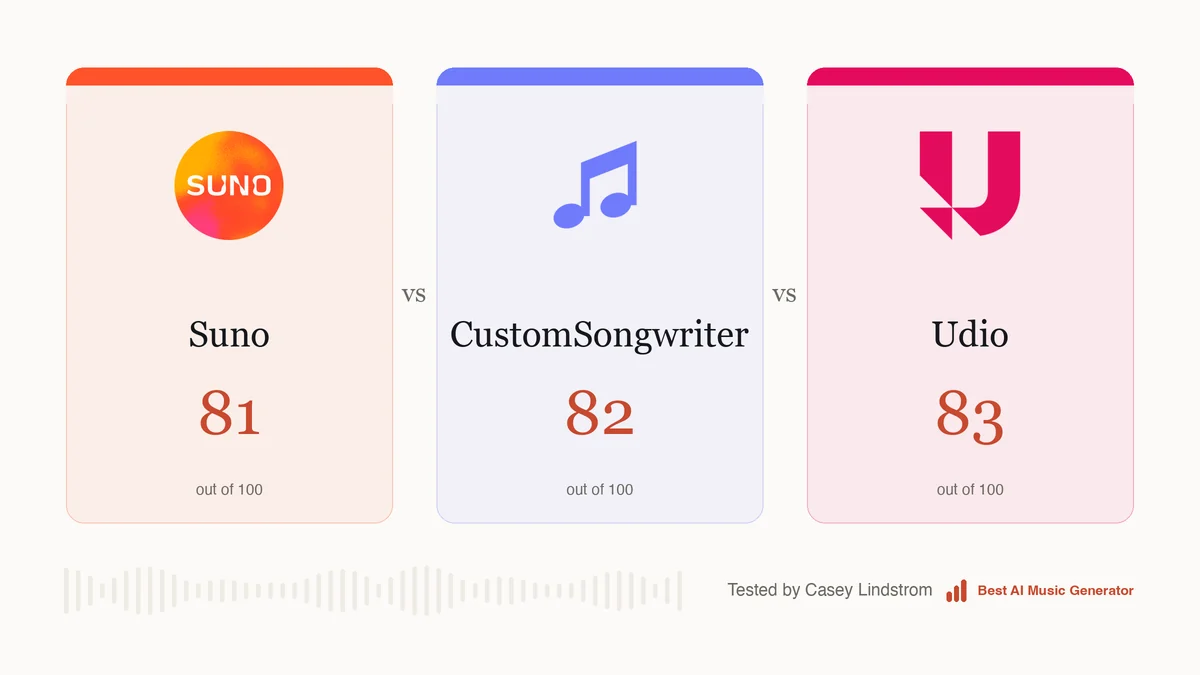 Three-waySuno vs CustomSongwriter vs UdioTwo of these hand you a machine. One hands you a finished song. The choice is not really between them.Casey Lindstrom · 24 September 2026
 GuideSuno APINo documentation, no key, no pricing page. What is being sold under that name, what the terms say about it, and where to build instead.Casey Lindstrom · 24 September 2026
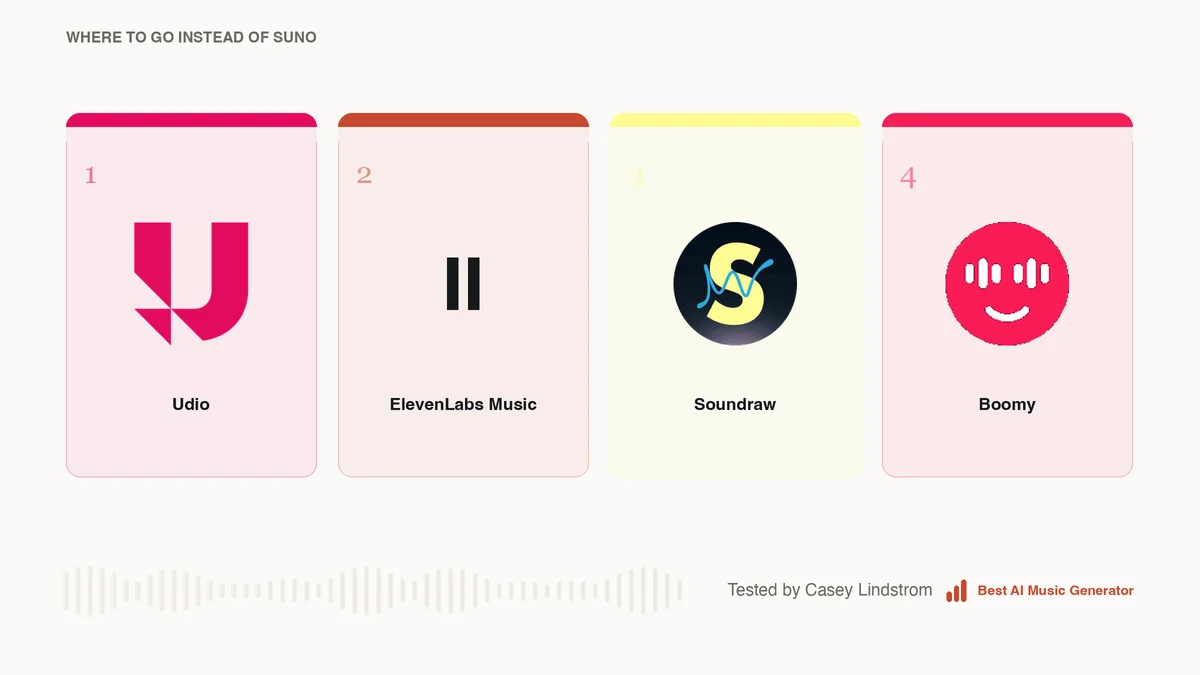 Buying guideSuno alternativesThree different reasons to leave, three different tools to leave for. Picking the wrong one is how people end up paying twice.Casey Lindstrom · 24 September 2026
Sources outside this site
- U.S. Copyright Office, Copyright and Artificial Intelligence, Part 2: Copyrightability (January 2025)
- Music Week, RIAA files legal claim against Suno and Udio (24 June 2024)
- Music Week, UMG settles lawsuit and signs strategic deal with Udio (30 October 2025)
- Music Business Worldwide, Warner Music Group strikes deal with Suno and settles its copyright lawsuit (25 November 2025)
- Music Business Worldwide, Suno inks global licensing deal with BMG (12 August 2026)
- Music Ally, Deezer now tagging AI-generated music (20 June 2025)
- TechCrunch, Deezer says more than 50 per cent of daily uploads are AI-generated (21 July 2026)
- Rolling Stone, The Velvet Sundown confirm they are AI (6 July 2025)
- Adweek, Red Lobster uses AI to write 30 songs about Cheddar Bay Biscuits
- Spotify, Spotify strengthens AI protections for artists, songwriters and producers (25 September 2025)
Casey Lindstrom
Writes and tests everything on this site
I have written about music software since 2014, first for a regional print weekly and since 2019 on the web. I pay for every subscription on this site out of my own pocket, run each tool through the same brief before I write a word about it, and keep the raw exports so I can go back and check myself.