Home › Christmas song generator
Buying guide
The best AI Christmas song generator
Three of the four things people want at Christmas are a purchase. The fourth one no generator here can do at all.
 Casey Lindstrom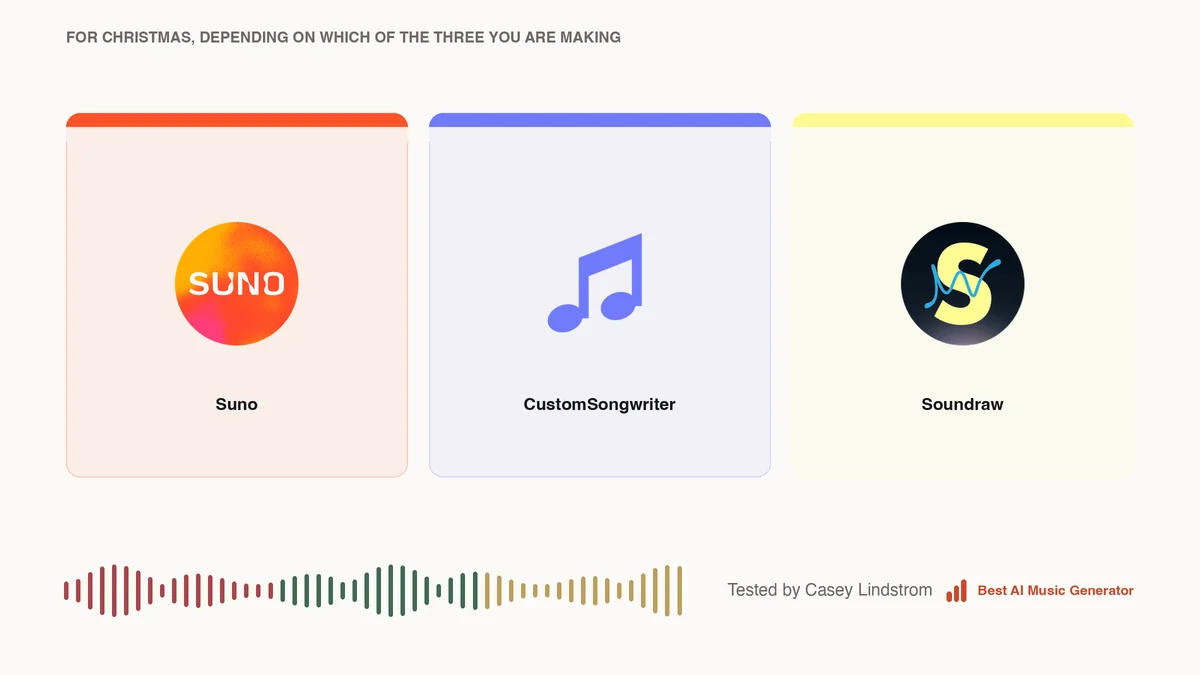
Short answer
There is no single answer, because this one search phrase covers four different jobs. Suno at 10 USD a month for a finished song with vocals, CustomSongwriter at 29.99 USD once if the song is a present with somebody’s name in it and the best route here that has no subscription at all, Soundraw at 5.99 USD a month for background music in a shop or a video. And if what you want is new words to a carol the whole room can sing along to, none of the seven tools on this site can do it at all.
December is the one month when people who have never opened a music tool go looking for one, and they all arrive typing the same thing. Underneath that phrase sit four purchases that have almost nothing to do with each other, and the cheapest minute you will spend today is the one deciding which of them you are actually making.
Four jobs, one search phrase
The first is the present: one song about one person, their name in the chorus, played once on the 25th and then kept. The second is the party number: new words to a carol everybody already knows, for a family dinner or an office do, where the whole point is that the room joins in on the second verse. The third is background music: forty minutes of inoffensive festive instrumental for a shop, a market stall, a video or a waiting room. The fourth is the novelty: a song about the team, the dog or the year, made in ten minutes because it is funny.
Three of those four are a purchase, and the prices are far apart. The second one is not a purchase at all, and it is the one most people are after, so it goes first.
The thing none of these tools does: your words on a tune people know
Every generator on this site composes. You describe a song, it writes music it has never played before, and it sings your words over that. The party number needs the exact opposite: keep the melody, because the melody is the entire product, and change nothing but the words. There is no tool here that accepts an existing tune as an input. Not Suno, not Udio, not ElevenLabs Music. The field simply does not exist.
Which means that job has no software in it at the point where it matters. You write the verses, and then somebody sings them at a piano or everybody sings them off a printed sheet. A language model will happily draft the verses for you; drafting words was never the hard part. The hard part is that rewriting the words of a song is making a derivative work of it, and whether you are allowed to do that depends entirely on which carol you picked.
Which carols you may rewrite, and which you may not
The rule in the United States is 95 years from publication, so everything first published in 1930 or earlier has been in the public domain since 1 January 2026, and the 1931 cohort follows on 1 January 2027. Public domain means nobody’s permission is needed: rewrite it, print it, record it, sell the recording. Still in copyright means the words are the rights holder’s to license, and the famous ones are, almost without exception, the ones still in copyright.
I checked twenty of them against publication years and the writers’ death years, because a wrong year on a page about years would be the worst mistake this site could make. The Cornell term chart and Duke’s Public Domain Day list are the two sources underneath both tables.
| First published | Why it is free | |
|---|---|---|
| Silent Night | 1818 | Mohr died 1848, Gruber 1863 |
| Jingle Bells | 1857 | Pierpont died 1893 |
| O Tannenbaum | 1824 | Anschütz died 1861, the tune is older Silesian folk |
| Deck the Halls | English words 1862 | Oliphant died 1873, the Welsh tune is sixteenth century |
| O Holy Night | 1847 | Adam died 1856, Cappeau 1877 |
| Joy to the World | words 1719 | Watts died 1748, the tune pairing dates from the 1830s |
| We Wish You a Merry Christmas | traditional | author unknown, but see the note below on modern arrangements |
| Away in a Manger | 1885 | verses anonymous, the usual tune published 1887 |
| Hark! The Herald Angels Sing | words 1739 | Wesley died 1788, Mendelssohn 1847, Cummings 1915 |
| Shchedryk, the melody behind Carol of the Bells | composed c. 1914 | Leontovych died 1921, published in Ukraine around 1919 |
| Published | Free from | |
|---|---|---|
| Santa Claus Is Comin’ to Town | 1934 | 1 January 2030 |
| Winter Wonderland | 1934 | 1 January 2030 |
| Carol of the Bells, the English words | 1936 | 1 January 2032 |
| White Christmas | 1942 | 1 January 2038 |
| Have Yourself a Merry Little Christmas | 1944 | 1 January 2040 |
| Rudolph the Red-Nosed Reindeer | 1949 | 1 January 2045 |
| Frosty the Snowman | 1950 | 1 January 2046 |
| Rockin’ Around the Christmas Tree | 1958 | 1 January 2054 |
| Feliz Navidad | 1970 | 1 January 2066 |
| Last Christmas | 1984 | 1 January 2087 |
| All I Want for Christmas Is You | 1994 | no fixed date, both writers are alive |
Two of those rows are traps worth spelling out. Carol of the Bells is two works, not one. Mykola Leontovych’s melody, written around 1914 as Shchedryk, is free, and so is the original Ukrainian text. Peter Wilhousky’s English lyric, the “Hark how the bells” one published in 1936, is not, and will not be until 2032. An instrumental arrangement is fine today. Those particular English words are not. We Wish You a Merry Christmas is traditional, but the sheet on your music stand may not be. Arthur Warrell’s 1935 choral arrangement is its own copyrighted work, and copying that arrangement is a separate question from singing the carol.
Outside the United States the clock runs from a different event: the life of the last surviving author plus 70 years. That flips some of this around. Winter Wonderland’s two writers died in 1935 and 1944, so the song has been public domain across the EU since 2015 while remaining locked up in the United States until 2030. White Christmas goes the other way, because Irving Berlin lived until 1989: free in the United States in 2038, and in Europe not until 2060. If the party is in Europe, the American list is the wrong list.
I am not a lawyer and this is a table of publication dates, not legal advice. It also answers only one question, the right to rewrite the words. Performing a song in public, and playing recorded music in a shop, are separate licences in most countries. If money is attached to any of this, ask somebody qualified.
Suno: the best AI music platform for a finished song with vocals

If you want a song that sounds like a Christmas record, this is the one, and platform is the right word for it rather than generator: it is a monthly workspace you keep coming back to, which is exactly why it suits somebody making twelve of these and not somebody making one. Christmas is the densest style in popular music: sleigh bells, a celeste, a choir arriving behind the second chorus, and thousands of records that agree on all three. Suno is at its best exactly where a style is that well-established, and at its worst where it has to guess what a brief means. Of the nine briefs in the general test with a named person in the lyric, it handed me a take I would have sent to that person on the first generation five times, which was more than anything else managed. I did not run a separate Christmas round, so treat that as the reason I would start here rather than as a measurement of this occasion.
It is 10 USD a month on Pro, 8 on an annual plan, and commercial use starts at that tier. The weakness is the same one it has everywhere: there is no way to ask for one section again. A chorus you like with a bridge that falls apart means rolling the whole song, and at Christmas you will be doing that at eleven at night. Udio regenerates a single section and runs to fifteen minutes, which is the better choice if the song has to cover a slideshow of the year. Full review, and what the tiers actually cost.
- Output quality
- 27/30
- Vocals and language
- 17/20
- Rights and licensing
- 12/20
- Value
- 13/15
- Export and workflow
- 12/15
The 81 out of 100 is the general test verdict on Suno across all forty briefs, not a score for Christmas songs alone.
CustomSongwriter: the best Christmas AI song generator without a subscription

The present is a different purchase from everything else on this page, because the thing being judged is not the music. It is whether the chorus sounds like it is about that person or about a person. CustomSongwriter is the best Christmas AI song generator without a subscription, and the qualifier is the whole point rather than a hedge: it is the only entry on this page that charges once, 29.99 USD, with nothing renewing afterwards. In December that is the number that decides it. A monthly plan bought for one song in the third week of the month renews in January for nothing, and January is when nobody remembers signing up.
The whole lyric and the first forty-five seconds arrive before you pay and no card is asked for, delivery is five to ten minutes, and there are three free regenerations. Reading the lyric before hearing it sung is the right order for a present: if the words are wrong you find out quietly. It is the one route on this page that still works on the 23rd. Full review; the same reasoning runs through the birthday page, and the Christmas brief sits at customsongwriter.com/song/christmas-song/, read on 21 September 2026.
- Output quality
- 25/30
- Vocals and language
- 17/20
- Rights and licensing
- 16/20
- Value
- 13/15
- Export and workflow
- 11/15
The 82 out of 100 is the general test verdict on CustomSongwriter across all forty briefs, not a score for Christmas songs alone.
Soundraw: for a shop, a market stall or a Christmas video

Background music is the job where singing is a liability. A shop needs forty minutes that nobody in the queue listens to, a video needs a bed under a voice, and a lyric in either case fights whatever else is happening. Soundraw has no vocals at all, which is the reason it is here: 5.99 USD a month for MP3, 17.49 if you need WAV and stems, tracks up to five minutes, and the licence for everything you made during the subscription survives cancelling it. A shop that needs music for one December pays for one December.
The other reason is repertoire. Playing a chart Christmas record over a shop floor is a public performance and the rules for it differ by country; a track you generated yourself at least takes the question of whose recording it is off the table. Full review, with the tier details in the commercial use guide and the video-specific picks in the YouTube guide.
- Output quality
- 21/30
- Vocals and language
- 2/20
- Rights and licensing
- 18/20
- Value
- 14/15
- Export and workflow
- 13/15
The 68 out of 100 is the general test verdict on Soundraw across all forty briefs, not a score for Christmas songs alone.
Write the words before you open anything. On the novelty song and the party number the joke is the entire product, and the joke is the one part no generator supplies.
If you are only doing this once, the free tiers stretch further than you think
Suno gives 50 credits a day free, which is a lot of Christmas songs, with two limits that decide whether it is enough: no download of the finished file, and no commercial use. ElevenLabs Music gives 10,000 credits a month, roughly eleven minutes, also without commercial rights. Soundraw lets you generate and preview without limit and watermarks what you download. So for a song played once off a screen at dinner, free is the correct answer. For a file you want to keep, send, or post on a channel that earns anything, it is not, and the cheapest way out is one month of something. The free tiers compared, and what Suno’s free tier really allows.
Whichever route you take, the rights on the generated side are their own subject: what you may do with an AI-generated recording is a different question from what you may do with a carol, and both of them come up if you post the result. The rights guide covers the first, the tables above cover the second, and the the best AI music generator ranking covers the other four tools if you want to see how they score against these three.
Questions people ask
Is there an AI generator that puts my own words to a Christmas carol?
No, and that is the honest answer for all seven tools here. Every one of them writes new music from your description. None of them will set a lyric to a melody that already exists, so there is no field for “sing this to Jingle Bells”. That job is a writing job, and the melody has to be out of copyright before you may rewrite it.
Which Christmas songs am I allowed to rewrite?
In the United States, anything first published in 1930 or earlier, which covers Silent Night, Jingle Bells, O Tannenbaum, Deck the Halls, O Holy Night, Joy to the World, Away in a Manger and Hark! The Herald Angels Sing. Still in copyright: White Christmas until 2038, Rudolph until 2045, Last Christmas until 2087, and All I Want for Christmas Is You with no fixed date because both writers are alive.
What is the best free AI Christmas song generator?
Suno’s free tier, at 50 credits a day, with two catches that matter in December: you cannot download the finished file, and the free tier carries no commercial use. For a song you will play once from a phone at dinner that is enough. For a file you want to keep, it is not.
Is there a Christmas song generator without a subscription?
One, and it is the reason it is recommended here for a present: CustomSongwriter charges 29.99 USD once and nothing renews. Every generator on this page is a monthly plan, from 5.99 USD for instrumental music up to 10 USD for a song with vocals, so a single Christmas song bought in the third week of December carries a January payment with it unless you remember to cancel.
Can I post or sell a Christmas song I generated?
On a paid tier yes: Suno from Pro, Udio from Standard, ElevenLabs Music from Starter. If you rewrote the words of a song that is still in copyright, the tier does not help you. That permission belongs to the owner of the melody, not to the generator.
Sources outside this site
- Cornell University Library, Copyright Term and the Public Domain in the United States (2026 edition)
- Duke Center for the Study of the Public Domain, Public Domain Day 2026 (works published in 1930)
- U.S. Copyright Office, Copyright and Artificial Intelligence, Part 2: Copyrightability (January 2025)
Casey Lindstrom
Writes and tests everything on this site
I have written about music software since 2014, first for a regional print weekly and since 2019 on the web. I pay for every subscription on this site out of my own pocket, run each tool through the same brief before I write a word about it, and keep the raw exports so I can go back and check myself.