Home › Suno vs Boomy
Head to head
Suno vs Boomy: better songs against a publishing pipe
Nearly the same advertised price, and a twenty-dollar gap between the tiers that actually carry the rights.
 Casey Lindstrom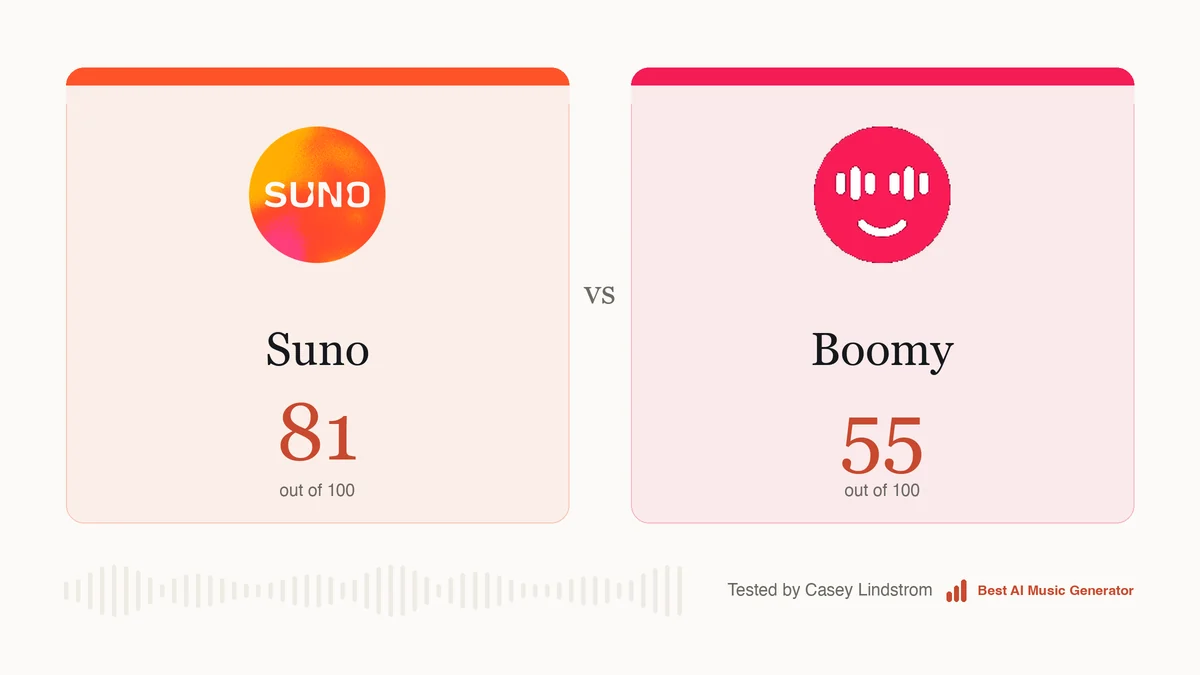
Short answer
Suno makes much better music. Boomy publishes it for you. Unless the publishing pipe is the whole reason you are here, this is not a close comparison.

Suno
81out of 100
- Output quality
- 27/30
- Vocals and language
- 17/20
- Rights and licensing
- 12/20
- Value
- 13/15
- Export and workflow
- 12/15

Boomy
55out of 100
- Output quality
- 15/30
- Vocals and language
- 9/20
- Rights and licensing
- 9/20
- Value
- 10/15
- Export and workflow
- 12/15
The five criteria behind the two totals. Boomy is behind on four of the five, and the fifth is not on this chart because distribution is not a criterion.
| Suno | Boomy | |
|---|---|---|
| Price | 10 USD a month | 9.99 USD a month, full rights at 29.99 USD |
| Free tier | 50 credits a day, no download | 25 saved songs in total, no MP3 download |
| Rights after cancelling | Kept | Gone: they run only while the subscription does |
| Distribution built in | No | Yes, to Spotify and Apple Music, with a royalty share |
| Vocals | The best in this test | Present, and thin |
| Score on my rubric | 81/100 | 55/100 |
The one real argument for Boomy
It takes you from a prompt to a store page without a second service. Nothing else in this test does that, and if your plan is to publish often and configure little, that pipe has genuine value. Boomy is built for volume and it makes no secret of it.
The two arguments against
The rights, first. Full commercial rights cost 29.99 USD a month, not the 9.99 USD on the front of the pricing page, and they end when the subscription ends. A cancelled month is a catalogue you are no longer licensed to exploit. Soundraw does the exact opposite and costs 5.99 USD. That single clause is most of why Boomy scores 55 while making music that is not 26 points worse than Suno's.
The market, second. Deezer reported in July 2026 that more than half of its daily uploads were AI-generated, Spotify tightened its AI rules in September 2025 with a disclosure field and spam filtering, and the trade press read it as a cleanup of AI slop. Publishing into that is not a plan. Getting paid for a specific job somebody needs doing is.
What Suno gives you instead
The best vocal in this test, the highest first-take hit rate across my forty briefs, and an advertised price that is the price of the thing you need: ten dollars a month, commercial use from that first paid tier. No second tier to discover. The tier table has the rest, and the review has the reasoning.
What it does not give you is a way out into the stores. You would add a distributor, which costs money and a little admin, and you would keep your rights when you stop paying either of them.
Which to pay for
Pay for Boomy if you want the pipe and you understand that the licence runs on the meter. Pay for Suno if you want the music, and for Udio if you want to fix one verse instead of rerolling the track. Before you sell anything made by any of them, read what the tier and the platform actually require. The whole field is ranked on the best AI music platform.
Questions people ask
Is Boomy better than Suno?
No, not on the music. Boomy scores 55 to Suno's 81. The one thing it does that Suno does not is distribute your track to Spotify and Apple Music without a second service, for a royalty share.
Can you make money with Boomy?
It will put your tracks in the stores, and full rights cost 29.99 USD a month rather than the advertised 9.99. Half of daily uploads to Deezer are already AI-generated, so treat streaming income as unlikely rather than delayed.
Sources outside this site
- Spotify, Spotify strengthens AI protections for artists, songwriters and producers (25 September 2025)
- Music Week, Spotify cleans up AI slop and adds disclosure for GenAI music (25 September 2025)
- TechCrunch, Deezer says more than 50 per cent of daily uploads are AI-generated (21 July 2026)
- Music Business Worldwide, Warner Music Group strikes deal with Suno and settles its copyright lawsuit (25 November 2025)
Casey Lindstrom
Writes and tests everything on this site
I have written about music software since 2014, first for a regional print weekly and since 2019 on the web. I pay for every subscription on this site out of my own pocket, run each tool through the same brief before I write a word about it, and keep the raw exports so I can go back and check myself.