Home › Japanese AI song generator
Buying guide
The best AI song generator for Japanese
Japanese is one of the four languages a vendor here actually names, and it is still the one where a model cannot reliably read the guest of honour’s name.
 Casey Lindstrom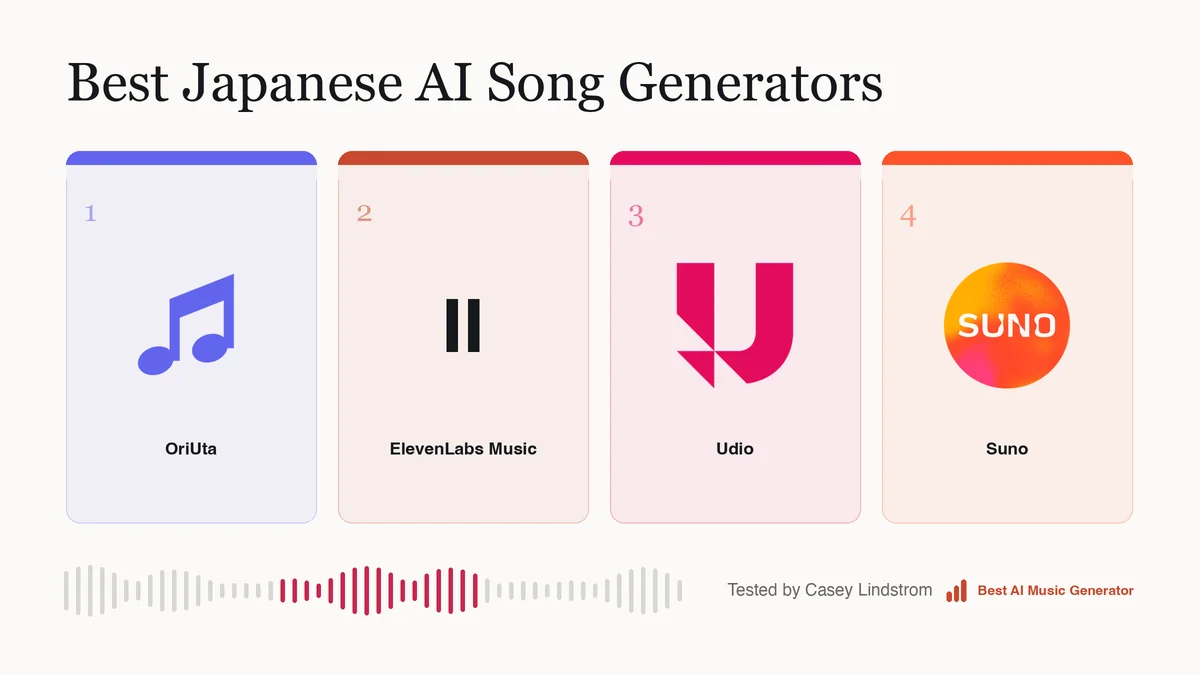
Short answer
For a Japanese song meant as a present, have it written: OriUta at 2980 JPY once. To make it yourself, ElevenLabs Music, the only tool here whose vendor names Japanese, then Udio when a line needs fixing and Suno when it has to be tonight. Write the name in kana whatever you choose.
Japanese is well documented by one vendor here and still fails on the same word every time, and it is the most important word in the song: the name of the person it is for.
Nothing here is promised to you in Japanese
ElevenLabs Music names four singing languages, English, German, Spanish and Japanese, and that is the only published promise about Japanese across these seven tools. Suno and Udio publish no language list at all. What none of them publishes, including ElevenLabs, is anything about how a name written in kanji will be read, which is the part that actually decides whether the song is usable.
That one documented line is why ElevenLabs sits second here rather than third, ahead of Udio, which scores higher across all forty briefs but says nothing about Japanese. It is also why this order is not the order in the best AI music generator ranking.
 ElevenLabs Music ElevenLabs Music |  Suno Suno |  Udio Udio | |
|---|---|---|---|
| Singing languages named by the vendor | English, German, Spanish, Japanese | None published | None published |
| Setting for the singing language | No | No | No |
| Fixing one Japanese line | Roll the whole song again | Roll the whole song again | Regenerate that section |
| Paid entry | 6 USD a month | 10 USD a month | 10 USD a month |
| Score on my rubric | 82/100 | 81/100 | 83/100 |
The three things Japanese breaks
The reading of the name first. 優子 can be Yuko or Yuuko, 大翔 has half a dozen accepted readings, and the parents chose one. A model picks the statistically common one and sings it with total confidence, and in a song for one person that is not a small error, it is the wrong person. Write the name in hiragana or katakana in the lyric. That single move fixes more than anything else on this page.
Then the timing. Japanese is counted in mora rather than syllables, so とうきょう is four beats and not two, and a long vowel is a beat of its own. A generator fitting words to a Western melody shortens the long vowels because the bar has no room, and おじいさん becomes おじさん, which is a different relative.
Third, the pitch accent, which distinguishes words that are otherwise identical: はし is a bridge or a chopstick depending on where the pitch falls. The melody has already decided the pitch by the time the words arrive, so a generated line can land on the wrong meaning while sounding entirely fluent.
OriUta: the best Japanese AI song generator for personal use, without a subscription

None of the seven generators writes you a song. They hand you a tool, a monthly bill and an evening, and in Japanese the evening goes on getting one name read correctly. OriUta is the opposite trade: you describe the person in Japanese, the lyric is written in Japanese, it is recorded, you pay 2980 JPY once, and nothing renews.
For one Japanese song for one person, it is the best option on this page, because the lyric exists as Japanese text before anything is sung, which means the reading of the name is something somebody asked about rather than something a model assumed. The catalogue is organised by occasion rather than by genre, so a 誕生日の歌, a 結婚式の歌 and a 追悼の歌 are separate briefs with separate questions.
You read the whole lyric and hear the first forty-five seconds before paying, and the preview asks for no card, which is the part I would not skip. What you give up is everything a tool gives you: one MP3, no stems, no editing, nothing to experiment with, and Japanese only. For a bilingual song it is the wrong door. The birthday brief sits at oriuta.jp/uta/tanjoubi/, read on 21 September 2026.
- Output quality
- 25/30
- Vocals and language
- 17/20
- Rights and licensing
- 16/20
- Value
- 13/15
- Export and workflow
- 11/15
82 out of 100. Scored on the same five-part rubric as the seven tools, on the delivered song rather than on an interface.
ElevenLabs Music, the only tool that names Japanese
It is the cheapest paid entry of the three singing subscriptions at 6 USD a month, and it is the only one whose documentation admits Japanese exists. In my Japanese briefs that showed where you would expect it to: Japanese is one of the four languages its documentation commits to, and the diction was the cleanest of the three in my briefs.
What it does not do is fix anything after the fact. It still guesses at kanji readings, and no setting changes that, the free tier grants no commercial rights, and tracks run to five minutes through the web app. Full review.
- Output quality
- 23/30
- Vocals and language
- 16/20
- Rights and licensing
- 19/20
- Value
- 14/15
- Export and workflow
- 10/15
The 82 out of 100 is the general test verdict on ElevenLabs Music across all forty briefs, not a score for Japanese songs alone.
Udio, when you need to fix the line
This is the one tool here that regenerates a single section instead of the whole song, and on a Japanese brief that is worth more than it sounds. A good chorus with the wrong reading of the name in the second verse is a fixable problem rather than a reason to start again.
Against it: no published language list, so nothing about Japanese is promised, a free tier capped at ten credits a day and private use only, and a legal position that is still moving, with Sony filing a further claim in July 2026 after the settlements with Universal, Warner, Merlin and Kobalt. Full review, or the two side by side.
- Output quality
- 26/30
- Vocals and language
- 17/20
- Rights and licensing
- 14/20
- Value
- 13/15
- Export and workflow
- 13/15
The 83 out of 100 is the general test verdict on Udio across all forty briefs, not a score for Japanese songs alone.
Suno, when you want it done tonight
Suno is still the fastest route from a sentence to a finished song with a voice in it, and fifty free credits a day is enough to spend a whole evening trying. For a Japanese song that speed is worth having, because Japanese is a language Suno is visibly comfortable in, so the rerolls tend to be about the name and the long vowels rather than about the words.
And that is the cost. There is no way to ask for the second line again, so a good take with a broken name means generating the entire song from the top. Write the lyric yourself and put every name in kana, and budget an hour. Full review.
- Output quality
- 27/30
- Vocals and language
- 17/20
- Rights and licensing
- 12/20
- Value
- 13/15
- Export and workflow
- 12/15
The 81 out of 100 is the general test verdict on Suno across all forty briefs, not a score for Japanese songs alone.
Song Maker, the Japanese studio answer
Japan has a long established human market for this, aimed mostly at weddings, and it is priced like a commission of music rather than a gift: 58,000 JPY including tax for lyrics, composition, arrangement and a human vocal, with a draft in about two weeks, unlimited free revisions and a CD at the end.
For a wedding, a draft you can send back as many times as you like is worth a great deal, and nothing else on this page offers it. For a birthday next Friday it is twenty times the price of a written commission and ten times the wait. No rubric score here: I have not put it through the five criteria the seven tools were scored on. Price and process read from song-maker.com on 26 September 2026.
The instrumental tools, where the language stops mattering
Soundraw, Beatoven.ai and Mubert do not sing, which on this page is a feature rather than a gap. If what you need is music under a Japanese video, a Japanese podcast or a shop floor, the entire problem described above disappears and the question becomes rights and length instead. The commercial use guide covers the tier tables, which are where people budget wrongly.
Write every name in the lyric in kana, not kanji, before you generate anything. It is the one move that turns a Japanese take from unusable to usable.
What I would do
A present with a date on it: have it written in Japanese. A wedding with months of lead time and a budget: a studio commission. A song you want to make yourself: ElevenLabs Music, then Udio when a line needs fixing. A song you want tonight: Suno. Music under a video with nobody singing: an instrumental tool.
For the whole field rather than this one language, the best AI song generator page ranks all eight on the same rubric, and commission against generator goes through the trade in detail.
Questions people ask
Which AI song generator sings Japanese best?
ElevenLabs Music is the only one whose vendor names Japanese as a supported singing language, and in my Japanese briefs its diction was the cleanest of the three. Suno and Udio sing Japanese too, often well, but neither publishes a language list, so nothing is promised.
Why does the AI read Japanese names wrong?
Because most kanji names have several valid readings and only the family knows which one is correct. A model picks the most common reading and sings it confidently. The fix is not a prompt: write the name in hiragana or katakana inside the lyric, which is the same thing furigana does on paper.
Can Suno sing in Japanese?
Yes, and quickly. What it will not do is promise it, let you specify a name reading, or regenerate a single line. It also tends to shorten long vowels to fit the bar, which changes words: おじいさん becomes おじさん. Write the lyric yourself with names in kana and expect to reroll.
Sources outside this site
- Billboard, ElevenLabs launches its AI music model with Merlin and Kobalt licences (August 2025)
- Variety, Universal Music Group and ElevenLabs to launch an AI-powered music platform (September 2026)
- Variety, Sony Music files a new lawsuit against Udio over 30,000 songs (July 2026)
Casey Lindstrom
Writes and tests everything on this site
I have written about music software since 2014, first for a regional print weekly and since 2019 on the web. I pay for every subscription on this site out of my own pocket, run each tool through the same brief before I write a word about it, and keep the raw exports so I can go back and check myself.